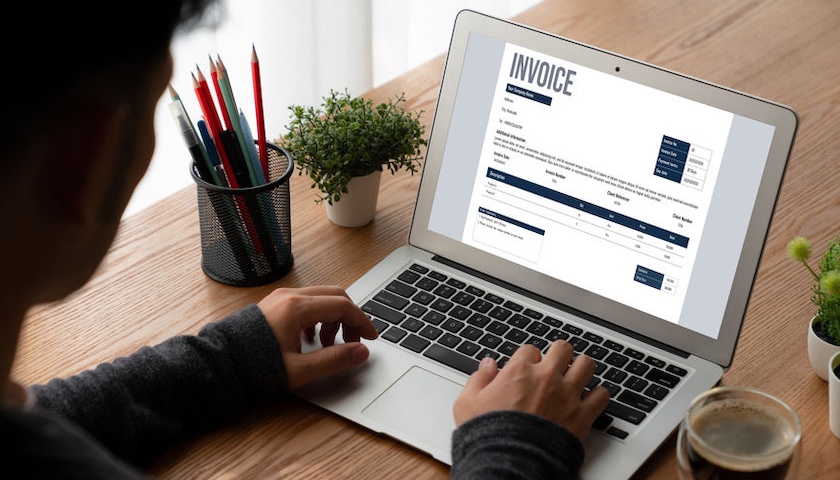
The UK e-invoicing mandate: what it means for your business
If you send invoices as PDF attachments, you might assume you’re already invoicing electronically — and under HMRC’s current VAT guidance, you’d be right. PDFs count as electronic invoices today. But from April 2029, that will no longer be enough. The government’s mandatory e-invoicing regime requires something more specific: structured, machine-readable invoice data flowing directly between financial systems. The PDF era of business invoicing is coming to an end.
This post explains what the UK e-invoicing mandate requires, why PDFs won’t make the cut, and what businesses should be doing now.
What is e-invoicing – and why isn’t a PDF one?
For the purposes of the UK’s new mandate, an e-invoice is not simply an invoice sent by email. It is a structured, machine-readable document that flows directly between the sender’s and recipient’s financial systems, without manual intervention. The invoice data is written automatically into the buyer’s accounting software – meaning there’s no printing, no re-keying and no human in the middle.
A PDF, by contrast, is a digital image of a document. It’s essentially ‘digital paper’. It has to be read by a person or optical character recognition software. Then its data has to be entered manually into the recipient’s system. From a technical standpoint, a PDF invoice is not meaningfully different from a printed one. You’ve saved on postage, but little else. That does not mean PDFs are irrelevant under today’s VAT rules – HMRC’s current guidance recognises them as a type of electronic invoice – but the government’s 2029 regime is aimed at structured data exchange, and specifically says PDFs, Word files, HTML invoices and OCR-based images are not e-invoices for that policy.
True e-invoicing uses standardised data formats – potentially including frameworks such as Peppol – to ensure invoices can be exchanged and processed automatically, regardless of which software each party uses. However, the government has not yet confirmed the final UK standard.
What has the government confirmed?
The UK e-invoicing mandate was confirmed at Budget 2025, following a consultation earlier in the year run jointly by HMRC and the Department for Business and Trade. The government has said that, from 1st April 2029, all VAT invoices issued between VAT-registered businesses (B2B) and between businesses and government bodies (B2G) must be issued in electronic format.
The mandate does not currently extend to business-to-consumer (B2C) transactions, so if your customers are private individuals rather than VAT-registered businesses, your invoicing to them will not be directly affected in the first instance.
One significant decision taken at Autumn Budget was to exclude real-time reporting to HMRC from the 2029 requirements. Some businesses feared that e-invoicing would be bundled with live data feeds to the tax authority, effectively giving HMRC a continuous window into transactional data. That will not be part of the initial mandate, though the government has indicated it may be explored further down the line once e-invoicing is established.
What happens between now and 2029?
The period from now to April 2029 is being used to prepare for the new UK e-invoicing mandate. What the government has clearly committed to so far is an implementation roadmap and standards to be published at Budget 2026, alongside extensive stakeholder engagement from January 2026. Beyond that, the detail is still being developed. Businesses will need adequate time to adapt, and the government has acknowledged that implementation support will be required, particularly for smaller firms.
The broad timeline appears to be as follows:
- Early 2025. HMRC and DBT consultation on e-invoicing was launched (February to May 2025)
- November 2025. The 2025 Budget confirmed the mandate and the consultation response was published
- 2026. The government is due to publish an implementation roadmap and standards at Budget 2026. There will be further stakeholder engagement through the year.
- 2027–2028. Businesses and software providers are likely to spend this period preparing for the detailed regime as further guidance and implementation detail emerge.
- April 2029. Mandatory e-invoicing for all VAT invoices (B2B and B2G)
Why the government is doing this – and what it means for your business
The government’s case for mandatory e-invoicing rests on several claimed benefits, backed by industry research cited in the consultation response. These are as follows:
- Reduced late payments. E-invoicing adoption has been associated with a 20% reduction in late payments in markets where it is established, with estimated annual savings of around £11,300 for small firms
- Productivity gains. Automation of invoice processing reduces administrative time and errors, with research suggesting a 2.2 times return on investment within two years of adoption
- Tax compliance. Structured data means fewer errors in VAT returns, as well as a reduced tax gap – which is a significant driver of HMRC’s interest in the reform
- Cash flow. Faster, automated invoice processing can speed up payment cycles and improve working capital management
It is worth noting that these figures come from industry research rather than independent academic studies, and that the benefits will not be evenly distributed. Larger businesses with high invoice volumes are likely to achieve the greatest efficiency gains. Smaller businesses with simpler invoicing requirements may find the transition more challenging than the headline figures suggest. This will particularly be so if they need to invest in new software or upgrade existing systems.
What should businesses be doing now?
April 2029 may feel distant, but the businesses that will find the transition smoothest are those that start preparing early rather than waiting for the final technical specifications to be confirmed. There are sensible steps you can take now without committing to any particular system or standard. These include the following:
1. Review your current invoicing processes
Understand how you currently issue and receive invoices. Are they generated from accounting software, or created manually in Word or similar? Do your customers and suppliers use compatible systems? Mapping your existing processes is the essential first step before assessing what needs to change.
2. Check your accounting software roadmap
Most major accounting software providers – including those already integrated with HMRC’s Making Tax Digital programme – are expected to develop e-invoicing functionality as the UK standards are confirmed. If you use cloud-based accounting software, speak to your provider or check their published roadmap for e-invoicing development. If you use older or more bespoke systems, this may require more significant planning.
3. Consider the connection to Making Tax Digital
If your business is already within the Making Tax Digital for VAT regime – as all VAT-registered businesses above the threshold should now be – you have already made some of the digital infrastructure investment that will underpin e-invoicing. MTD requires digital record-keeping and digital submission of VAT returns, and e-invoicing will extend that digital requirement to the invoices themselves. The two programmes are complementary, but they are not the same thing. Businesses already operating MTD-compliant software are well-positioned for the transition.
4. Watch for further announcements
The detailed technical standards for UK e-invoicing have not yet been confirmed. What has been confirmed is that the government will publish an implementation roadmap and standards at Budget 2026 and continue stakeholder engagement as it develops the regime. The broad goal is interoperability – ensuring (for example) that if you use Xero and your supplier uses FreeAgent, the systems talk to each other without a middleman. We will be keeping a close eye on developments and will be very happy to advise you as the picture becomes clearer.
How THP can help you with the UK e-invoicing mandate
If you’d like to discuss how the UK e-invoicing mandate might affect your business, or to review your current digital accounting arrangements, please get in touch with your usual THP contact or call one of our offices.
Frequently asked questions
Is e-invoicing mandatory in the UK now?
Not yet. E-invoicing is currently permitted but not required. The mandate is planned from April 2029 and will apply to VAT invoices in B2B and B2G transactions.
Does the mandate apply to all businesses?
The mandate applies to VAT-registered businesses issuing VAT invoices in B2B and B2G transactions. It does not currently extend to business-to-consumer transactions. Smaller businesses below the VAT registration threshold are not directly affected. However, they may find that customers or suppliers require e-invoicing in practice.
Will HMRC be able to see my invoices in real time?
Not under the 2029 mandate. The government has confirmed that real-time reporting to HMRC will not be part of the initial regime. However, it has indicated that the potential benefits of real-time reporting may be explored further in the future once e-invoicing is established.
Is a PDF invoice acceptable under the new rules?
Not for the purposes of the new mandate. HMRC’s current VAT notice treats PDFs as a form of electronic invoice in a broad sense. But for the government’s 2029 e-invoicing regime, PDFs, Word files, HTML invoices and OCR-based images are expressly outside the definition of e-invoicing. The mandate is aimed at structured, machine-readable invoice data that can be processed automatically by the recipient’s financial system.
What software will I need?
The technical standards are still being confirmed. The government has said it will publish an implementation roadmap and standards at Budget 2026. Most established accounting software providers are expected to develop e-invoicing capability as the standards become clear. If you are currently using MTD-compatible software, your provider is likely to be working on this already.

About Kirsty Demeza
With a portfolio that ranges from startups to companies with a £10 million turnover, Kirsty’s talent for working closely with her clients ensures her services remain in strong demand.
“The most rewarding part of my role is seeing clients succeed,” she says. “When you help a new business and watch it expand into new premises and secure big contracts, it’s a great feeling.” Kirsty never finds two days are the same.
As well as providing accounting services that range from self-assessment tax planning and VAT to audit and accounts, she’s part of THP’s sales team and closely involved in helping our trainees to develop their skills.
Read more about Kirsty Demeza More posts by Kirsty DemezaRelated Posts

Should I increase rent on my buy-to-let properties?
Partial exemption for VAT: a 2026 guide for mixed-supply businesses

Spring Statement 2026: what it means for you

From guard dogs to ‘trivial’ treats: a guide to unusual business expenses

7 dos and don’ts for business success