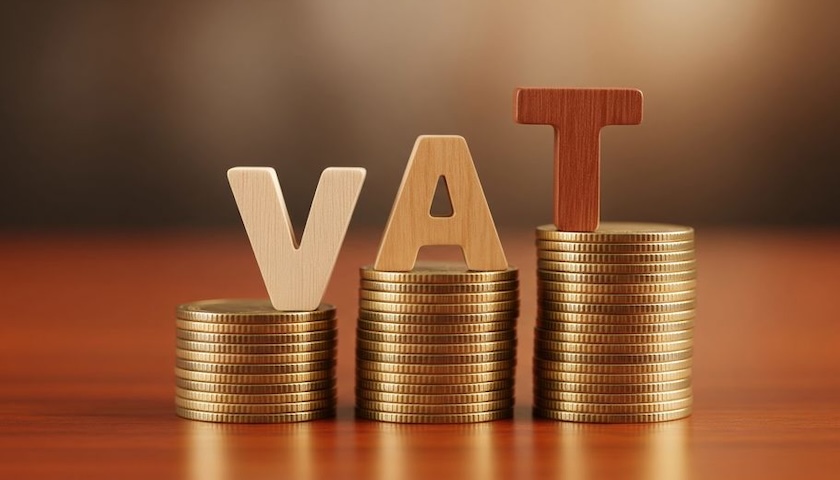
VAT on disbursements: when should you charge VAT?
If you regularly pay expenses on behalf of your customers and then bill them for the costs, you might assume you can simply pass them on without adding VAT.
Unfortunately, it isn’t always that simple. The rules on VAT on disbursements make an important distinction between costs you incur while providing your services and payments you make directly on behalf of a customer.
Get the distinction wrong and you could end up undercharging VAT, leaving your business liable for tax that should have been collected. Alternatively, you might be charging VAT unnecessarily.
So, what’s the difference between a disbursement and a recharged expense? And how can you make sure you’re getting your invoices right?
What is a disbursement for VAT purposes?
A disbursement is a payment you make to a third-party supplier on behalf of your customer.
The important point is that you’re acting as the customer’s agent. Your customer is buying the goods or services from the third party, and you’re simply arranging or paying for them.
For example, imagine you’re handling some administrative work for a client. You pay a £60 statutory filing fee that the client is legally responsible for, having been authorised to do so on their behalf.
Provided the transaction meets HMRC’s conditions, you can normally pass that £60 on as a disbursement without adding VAT.
This is because you’re not making a supply of your own when you recover the payment. You’re simply recovering money spent on the customer’s behalf.
However, just because you call something a disbursement on your invoice doesn’t mean HMRC will agree that it is one.
What’s the difference between a disbursement and a recharged expense?
This is where many businesses make mistakes.
Let’s say you’re a consultant who travels by train to visit a client. Your return ticket costs £100 and you’ve agreed that the client will reimburse you for your travelling expenses.
When you invoice the client, you include the £100 train fare as a separate item.
You might think that because you’re merely recovering the cost, there’s no VAT to pay. After all, domestic train fares are generally zero-rated for VAT.
But that’s not how the rules work.
The train journey was a service supplied to you, not your client. You incurred the expense to carry out your own work.
Therefore, if you’re VAT-registered and your consultancy services are standard-rated, you must charge VAT on the £100 recharge.
That means:
- Train fare: £100
- VAT at 20%: £20
- Total charged to the client: £120
The same principle generally applies to hotel accommodation, your own postage expenses and other costs incurred while providing services.
The fact that you haven’t made a profit on the expense doesn’t change its VAT treatment.
In most cases, a recharge forms part of the payment for your own supply and follows the VAT liability of that supply.
What are HMRC’s rules on VAT disbursements?
To treat a payment as a disbursement and exclude it from your VAT calculations, HMRC says you must satisfy eight conditions.
In summary:
- You acted as your customer’s agent when making the payment.
- Your customer received, used or benefited from the goods or services.
- The customer was responsible for paying the third-party supplier.
- You had the customer’s permission to make the payment.
- The customer knew that the goods or services came from a third party.
- You show the payment separately on your invoice.
- You recover exactly the amount paid, without adding a markup.
- The goods or services are additional to those you supply yourself.
All eight conditions must be met. You can’t simply choose the ones that apply to your circumstances.
HMRC places particular importance on identifying who actually receives the third party’s supply.
If your business receives the goods or services and uses them to carry out work for a customer, the cost will generally be a recharge rather than a disbursement.
You can read the full requirements in HMRC’s guidance on costs and disbursements.
How should you show disbursements on an invoice?
Let’s look at another example.
Suppose your VAT-registered business provides £900 of standard-rated consultancy services to a customer.
You also charge £100 for travelling expenses incurred while carrying out the work.
Separately, you pay a £60 statutory fee on the customer’s behalf. The customer is responsible for the fee, has authorised you to pay it and all eight conditions for a disbursement are satisfied.
Your invoice would look something like this:
| Description | Amount |
|---|---|
| Consultancy services | £900 |
| Recharged travelling expenses | £100 |
| Subtotal subject to VAT | £1,000 |
| VAT at 20% | £200 |
| Disbursement – statutory fee | £60 |
| Total payable | £1,260 |
Notice that VAT is charged on the consultancy fees and travelling expenses, but not on the qualifying disbursement.
It’s important that genuine disbursements are clearly identified on your invoices and that you retain evidence supporting their treatment.
For more help with invoicing, see our guide to VAT invoice requirements.
Can you reclaim VAT on disbursements?
Here’s another important distinction.
If you’re paying for goods or services that are supplied directly to your customer, you can’t reclaim any VAT charged by the third-party supplier if you treat the payment as a disbursement.
That’s because the goods or services weren’t supplied to your business.
Your customer may be able to reclaim the VAT instead, provided they’re VAT-registered, the purchase is eligible and they have a valid VAT invoice.
On the other hand, if you incur an expense in the course of providing your own services, you may be able to reclaim the input VAT under the normal rules.
For example, VAT on eligible hotel accommodation used for business purposes may be recoverable, subject to the usual conditions.
You would then account for VAT on the amount recharged to your customer, where appropriate.
It’s worth remembering that VAT recovery and the VAT you charge your customer are separate questions. Being unable to reclaim VAT on a particular expense doesn’t automatically mean you can recharge it without VAT.
Common VAT mistakes to avoid
There are several ways businesses can get caught out by the rules.
One is assuming that an expense is a disbursement simply because it appears separately on an invoice. Another is treating every payment made to a third party as a disbursement, even when the goods or services were supplied to the business itself.
You also need to be careful about expenses that were originally exempt or zero-rated for VAT. As we’ve seen with train fares, recharging these costs can still create a VAT liability.
Finally, make sure you keep adequate records. If HMRC questions your treatment of a disbursement, you’ll need evidence that you were acting on the customer’s behalf and that you met the relevant conditions.
That might include the original supplier’s invoice, written instructions from your customer and records showing the exact amount paid.
Need help with VAT on disbursements?
The difference between disbursements and recharged expenses might seem like a technicality, but getting it wrong can lead to unexpected VAT bills.
This is particularly important if your business regularly incurs costs on behalf of customers, whether you’re a consultant, professional services provider or another type of small business.
If you’re uncertain about how to treat particular expenses, it’s worth seeking advice before issuing your invoices. It’s usually much easier to get the VAT treatment right at the outset than to correct mistakes later.
At THP, we help businesses navigate VAT rules, prepare accurate returns and avoid costly errors.
If you’d like advice about VAT on disbursements or any other aspect of VAT accounting, speak to your THP account manager or find out more about our VAT returns service.

About Mark Ingle
Owner-manager business specialist, Mark Ingle is key to building relationships with clients at the Chelmsford office. “I like to see clients enterprises grow and succeed.” Mark explains, “The team here has a lot to offer and I can see a lot of new businesses responding to that.”
Having worked for accountancy practices in London and Essex, Mark has worked with a range of companies varying in size. For Mark, THP stands out for its “local firm approach with the resources of a larger practice.”
Although a keen traveller, Mark is focused on giving his clients at THP the highest service, “Right now, I aim to help the clients we have to the best of my ability which will help me attract more of the right clients in the future.”
Mark’s specialist skills:
- Annual and Management Accounts
- Tax and VAT
- Strategy and Business Planning
- Marketing and Sales
- Business Development
Related Posts

VAT on ecommerce sales: what’s changing for eBay, Amazon and Etsy sellers in 2027?
VAT One Stop Shop rules for EU B2C sales

VAT on deposits: when do you need to pay HMRC?
VAT deregistration: when can you deregister for VAT?
VAT invoice requirements – don’t let your claims get rejected!